
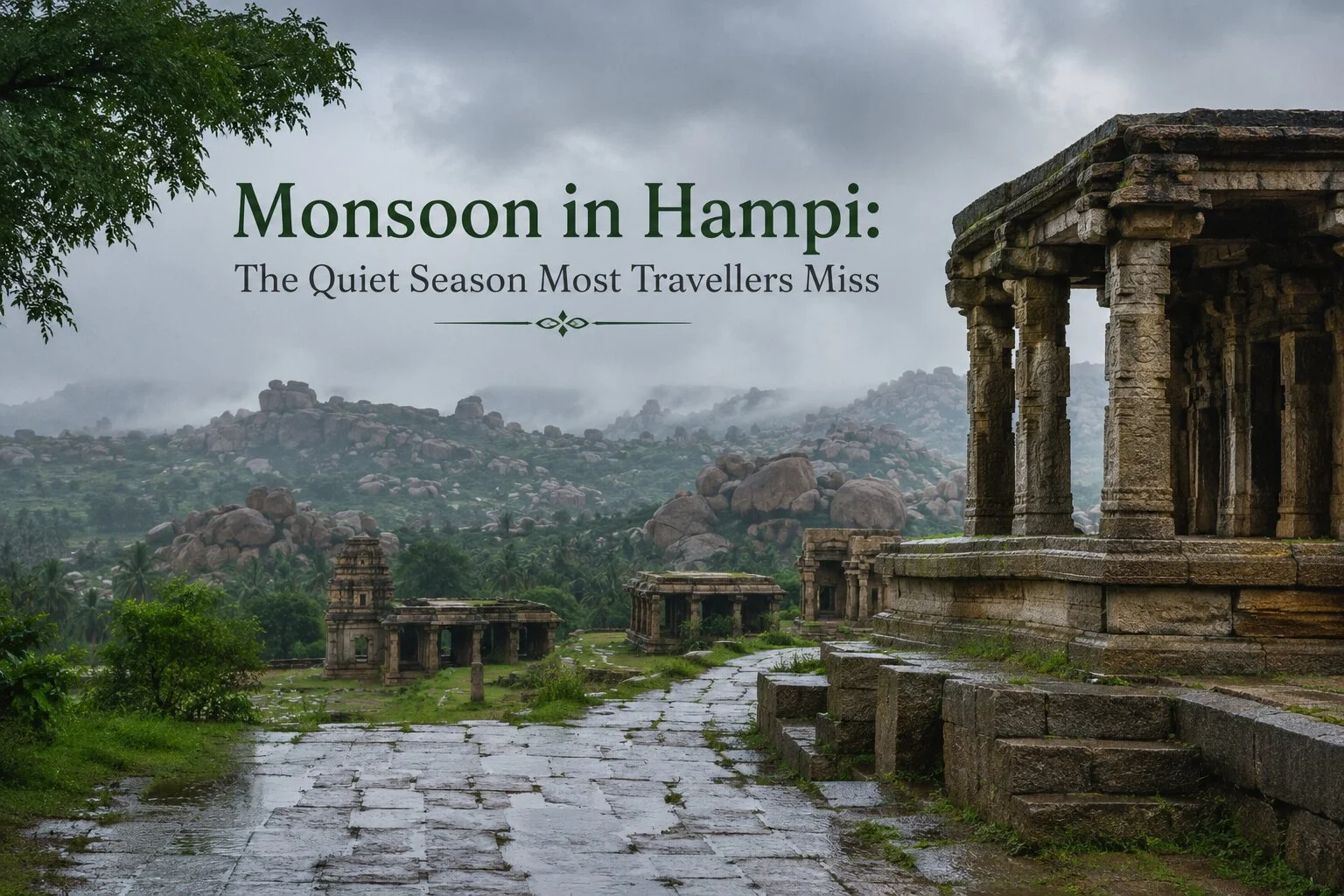
Every October, the crowds return to Hampi and describe it as the best time to visit. They are not wrong. But there is another Hampi — wetter, greener, emptier, and in some ways far more extraordinary — that most of them have never seen.
The guidebooks are consistent on this. October to February is the recommended window. The weather is pleasant, the ruins are accessible, the boulders are dry enough to climb. The Hampi Utsav festival fills the ancient site with music and light. Come in winter, the guides say, and you will not be disappointed.
They are right. But they are describing only one version of Hampi.
Between July and September, when the Southwest Monsoon arrives across Karnataka, something happens to this UNESCO World Heritage Site that the dry-season visitors never witness. The boulder fields — all those extraordinary piles of ancient granite that define Hampi’s impossible landscape — turn dark and mossy. The banana plantations that fill the gaps between ruins erupt in the specific, saturated green that only monsoon rain can produce. The Tungabhadra River, which runs quietly along the northern edge of the site in winter, swells and quickens and fills with a drama that changes the whole character of the place.
And almost nobody is there to see it.
This is the Hampi that the monsoon reveals. This guide is for the traveller who wants to find it — and for those who want to know where to stay in Hampi when they do.
WHAT THE MONSOON DOES TO HAMPI
The Transformation
Hampi exists in two entirely different states across the calendar year. Most travellers only ever see one of them.
The dry-season Hampi — October through May — is extraordinary in its own right: rust-red boulders against blue sky, ancient temple towers rising from a landscape that looks like it was designed by a civilization with access to geological forces ordinary architects could never command. It is dramatic, alien, and genuinely unlike anything else in India. The colours are warm and dusty, the air is clear, and the shadows of the ruins are sharp and photogenic.
The monsoon Hampi is something else. The same boulders become covered in a fine coat of moss and lichen that turns them from rust-red to deep green-black. The rice paddies that surround the archaeological zone fill and shimmer. Wildflowers appear in the cracks of 600-year-old stone walls. The air, which is dry and dusty for most of the year, smells of wet earth and rain and the specific botanical richness of Karnataka in full growth.
The Tungabhadra in Monsoon
In winter, the Tungabhadra is a river you can watch serenely from a coracle, drifting gently between the north and south banks. In monsoon, it becomes something altogether more powerful. The river swells to fill its banks and beyond, moving with a speed and volume that makes it genuinely impressive. The coracle crossings are suspended during the peak of the rains — usually July and August — because the current is too strong. But the river itself, viewed from the ghats or from the Virupaksha Temple courtyard, is one of the most dramatic sights the monsoon creates in all of Hampi.
The ancient dam at Tungabhadra — still functioning centuries after it was first built — holds and releases water in patterns that the Vijayanagara engineers understood better than most modern observers give them credit for. Watching the dam in full monsoon flow is one of the lesser-known experiences of the season.
The Light
Every photographer who has visited Hampi in both seasons will tell you the same thing: the monsoon light is different. Cloud cover diffuses the harsh direct sunlight that makes dry-season photography difficult between 9 AM and 4 PM. In monsoon, the light is soft and dramatic simultaneously — the kind of overcast-but-luminous sky that makes ancient stone look ancient in precisely the right way. The Vittala Temple’s Stone Chariot, already one of India’s most photographed monuments, looks genuinely otherworldly when the dark granite glistens after a rain shower and the sky behind it is the particular grey-white of a monsoon afternoon.
“The boulders turn mossy green, the banana plantations flourish, and the Tungabhadra fills and rushes dramatically. Sunset over the river in July, with storm clouds over the ruins, is genuinely one of India’s great travel photographs.” — Hampi Travel Guide 2026
WHAT TO DO
The Monsoon Hampi Experience — Temple by Temple, Ghat by Ghat
The practical reality of a monsoon visit to Hampi is different from the dry season, not lesser. Some activities are suspended — boulder climbing and high Matanga Hill treks are inadvisable on wet rock. Others become available only in this season — the river at full monsoon volume, the green paddies, the specific quality of the ruins under rain.
Here is what the monsoon reveals, experience by experience:
Virupaksha Temple — The Heart of Hampi in Any Season
The oldest continuously functioning temple in the entire Hampi site — active since at least the 7th century CE — Virupaksha Temple is the spiritual anchor of every visit regardless of season. In monsoon, the experience is heightened by the rain-cooled air inside the stone corridors, the incense that mixes with the smell of wet stone, and the relative quiet. The extraordinary camera obscura in the main gopuram — a natural projection of the inverted temple tower created in a dark chamber inside the structure — is one of Hampi’s genuinely astonishing features that most visitors never find. Ask a priest to show it to you; the monsoon quiet makes priests more available for such conversations than the peak-season rush allows.
- Timings: 6:00 AM – 1:00 PM and 2:30 PM – 8:30 PM
- Entry: Free (camera ₹50)
- Monsoon advantage: Significantly fewer visitors — intimate, genuinely devotional atmosphere
Vittala Temple & The Stone Chariot
The architectural peak of the Vijayanagara Empire, and the monument that most visitors name as Hampi’s crowning achievement. The musical pillars of the main hall — each carved to produce a distinct note when struck — and the famous Stone Chariot in the courtyard are extraordinary in any weather. In monsoon, the chariot’s dark stone absorbs the rain and glistens under overcast sky in a way that the dry-season photographs, however spectacular, simply cannot replicate.
Practical note: Wear rubber-soled footwear. The stone path to Vittala is slippery in rain. Start early — by 7 AM the light is soft and the site is empty.
Hemakuta Hill — Sunset Panoramas Under Storm Clouds
The hill that rises just south of Virupaksha Temple is lined with pre-Vijayanagara temples and shrines that predate the empire. At sunset in the dry season, Hemakuta is crowded with visitors watching the orange sky over the ruins. In monsoon, the crowds disappear and the sky delivers something more spectacular: storm clouds moving across the boulder landscape with the last light breaking through in shafts. This is the image that serious Hampi photographers specifically travel in monsoon to capture.
The rocks here are slippery after rain — climb with care and wear appropriate footwear. The best position for the light is the western face of the hill between 5:30 PM and 7:00 PM.
The Royal Centre — Lotus Mahal, Elephant Stables, Zenana Enclosure
The cluster of palaces and administrative structures that formed the functioning heart of the Vijayanagara Empire is particularly atmospheric in monsoon. The Lotus Mahal — a two-storey pleasure pavilion whose arches are designed to channel air in a sophisticated natural cooling system — sits in the Zenana Enclosure surrounded by trees that are at their most lush in the rains. The Elephant Stables, with their domed chambers that once housed the ceremonial elephants of the empire, catch the diffuse monsoon light in a way that the harsh dry-season sun never allows.
The Royal Centre is 3 km from Hampi Bazaar — hire an auto-rickshaw from the main road. Most autos will wait for you to explore and bring you back.
The Tungabhadra Ghats — River Watching at Its Most Dramatic
Even when the coracle crossings are suspended, the ghats along the Tungabhadra are worth visiting simply to watch the river in full monsoon volume. The ancient stepped ghats — some of them dating to the Vijayanagara period — lead down to a river that is, in July and August, genuinely powerful. Local fishermen and priests who perform their daily rituals at the ghats regardless of season are some of the most interesting subjects for photography in all of Hampi.
By September, the rains begin to ease and the river settles to a level that makes coracle crossings possible again. A September monsoon visit gives you the green landscape and the river drama while recovering the full mobility of the dry season.
Village Cycling — The Ricefields Come Alive
One of the most distinctive monsoon experiences at Hampi — and one that simply does not exist in the dry season — is cycling through the surrounding villages when the rice paddies are full and bright green. The countryside between the archaeological zone and the Anegundi village on the northern bank transforms completely in the rains. The contrast of ancient stone ruins with intensely cultivated green fields is the specific visual quality that defines Hampi’s landscape at its most extraordinary.
Vijayshree Resort & Heritage Village can arrange guided cycling excursions through the surrounding villages and plantation areas — one of the most recommended monsoon-specific experiences for guests at the resort.
THE PRACTICAL CASE
Why the Monsoon Is Actually the Right Time to Visit
Every season in Hampi has its advocates. Here is an honest comparison:
Crowds — or the Beautiful Absence of Them
October through February, Hampi receives the bulk of its annual visitors. The major monuments — Vittala Temple, Virupaksha, the Stone Chariot — have queues. The Hampi Bazaar area is busy. The most scenic spots for sunrise and sunset photography are occupied. Accommodation is at peak pricing and the best rooms book out weeks in advance.
In monsoon, the visitor numbers drop dramatically. The same monuments that require queuing in December are available for personal, unhurried exploration in August. A traveller who wants to sit quietly in the Vittala Temple’s main hall and actually hear the musical pillars without competing for attention from fifty other visitors can do so in the monsoon in a way that October and November simply do not allow.
Temperature — Cool and Comfortable
Hampi’s reputation as a difficult summer destination is deserved — temperatures above 40°C make daytime exploration genuinely difficult from April through June. The monsoon brings relief: temperatures settle between 25°C and 33°C, with the rain keeping the air cool and the stones from heating to the uncomfortable levels they reach in summer. Monsoon Hampi, contrary to the standard advice, is one of the more comfortable thermal environments in the site’s calendar year.
Pricing — The Season’s Other Secret
Monsoon is Hampi’s low season, and accommodation pricing reflects this. The same rooms and villas that command peak-season rates in December are available at monsoon rates that represent some of the best-value luxury stays in Karnataka. For travellers with flexible schedules, a July or August visit to Vijayshree Resort delivers a significantly richer value proposition than the same stay in November.
What to Know Before You Go
- Coracle crossings: Suspended during peak monsoon (usually July–August when the Tungabhadra is highest). The northern bank (Virupapur Gaddi / Hippie Island) is inaccessible during this period — plan all sightseeing from the southern bank.
- Boulder climbing: Not recommended when wet. The boulders are genuinely dangerous with any moisture. Matanga Hill and Anjanadri Hill treks should be avoided after or during rain.
- Footwear: Rubber-soled shoes or waterproof sandals throughout. The temple floors and stone paths become slippery.
- Timing: Start temple visits by 7:00 AM to take advantage of rain-free early mornings and the soft monsoon light before afternoon showers build.
- Packing: A lightweight rain jacket or compact umbrella. The rain in Hampi is typically intermittent rather than continuous — short, powerful showers followed by dry windows.
WHERE TO STAY IN HAMPI
Vijayshree Resort — The Right Base for the Monsoon Visit
The question of where to stay in Hampi is answered differently depending on what you want from the visit. For travellers who want proximity to the ruins, pure vegetarian dining, and a resort environment that enhances rather than competes with the experience of the site — Vijayshree Resort & Heritage Village is the consistent answer.
Set across 20 acres of manicured gardens near the Royal Centre of the Vijayanagara ruins, Vijayshree Resort is one of the best resorts in Hampi and the largest heritage property in the area. In monsoon, the resort’s gardens — already striking in the dry season — become a lush, tropical environment where the monsoon rainfall turns the 20 acres into something that feels genuinely removed from the outside world.
The Resort in Monsoon
The 20 acres of Vijayshree Resort take on a specific quality in the rains. The manicured gardens between the cottage clusters deepen in colour. The pathways through the resort — already atmospheric in dry season — become canopied by overhanging trees at the peak of their growth. The swimming pool, surrounded by greenery, is at its most visually striking when the landscape around it is fully saturated.
The resort’s philosophy — pure vegetarian, smoke-free, alcohol-free, oriented toward wellness and mindfulness — aligns particularly well with the slower, more contemplative rhythm that the monsoon imposes on Hampi. There is less to rush toward in the monsoon season. More reason to sit with the sound of rain on stone, to eat a considered meal, to move through the ruins without an agenda.
Accommodation — 97 Rooms and Cottages Across Seven Categories
Vijayshree Resort’s room portfolio spans seven categories, from the accessible Heritage Kutiya cottages to the Presidential Suite and the Palace Wing’s flagship Hemakuta Suite:
- Hemakuta Suite (750 sq ft): The resort’s most exclusive offering, located in the Palace Wing. Inspired by the lifestyle and architecture of the Vijayanagara era. In monsoon, the suite’s private setting within the resort feels particularly secluded — the green gardens outside the windows completing the picture.
- Raya Rooms (300 sq ft): Also in the Palace Wing, with premium amenities and a lavish bathroom. The new Palace Wing rooms combine the heritage aesthetic of the wider resort with contemporary comfort standards.
- Heritage Kutiya (350 sq ft): The classic Vijayshree cottage experience — fully equipped, globally charming, and set among the resort’s garden clusters. The monsoon greenery around the Kutiyas is among the most photographed aspects of the resort in the wet season.
- Heritage Villa (350 sq ft): Situated in a beautiful location surrounded by orchards, the Heritage Villas offer natural views that are at their most spectacular in the rains when the orchards are in full leaf.
- Garden Villa (350 sq ft): Designed for romance, luxury, and tranquillity — the Garden Villa’s combination of lush surroundings and intimate setting is particularly well-suited to couples visiting in the quieter monsoon season.
- Royal Haveli (600 sq ft): Designed for families, the Royal Haveli provides the space to immerse in the resort’s nature fully — the extra square footage is well-used when rain creates afternoon indoor time.
- Presidential Suite (700 sq ft): The Cottage Wing’s most prestigious accommodation, with beautifully planned interiors adorned with works of art. One of Hampi’s finest places to stay in Karnataka in any season.
Dining
Vijayshree Resort’s pure vegetarian dining philosophy takes on a different quality in the monsoon. Karnataka’s monsoon cuisine — the specific dishes that the season’s produce and the cooler temperature make appropriate — is best experienced in a setting that is genuinely embedded in the landscape. The resort’s dining spaces, surrounded by gardens at full monsoon growth, provide exactly this context.
For guests who want the complete monsoon experience, a meal taken in the evening as rain sounds on the resort’s gardens and the lights of the cottage cluster reflect on wet stone pathways is one of those specific travel memories that no peak-season visit can replicate.
Experiences at the Resort in Monsoon
Vijayshree Resort offers a range of curated experiences that work particularly well with the monsoon visit:
- Village cycling tours: Through the rain-green plantations and village lanes surrounding the site — available through the resort’s activities team.
- Heritage walks: Guided exploration of the Vijayanagara ruins with the resort’s knowledgeable team — early morning walks before the rains build are among the most memorable monsoon experiences the resort offers.
- Ayurvedic spa treatments: The resort’s spa is particularly well-aligned with the monsoon — traditionally one of the most auspicious seasons for Ayurvedic treatment in Indian medicine.
- Photography sessions: The resort can connect guests with guides who know the optimal monsoon light locations across the site — Hemakuta Hill, the Stone Chariot at Vittala, the Tungabhadra ghats.
PLANNING YOUR VISIT
Practical Guide: Visiting Hampi in Monsoon
When to Go
- July: Peak monsoon. Heaviest rainfall, fullest river, most dramatic landscapes. Coracle crossings suspended. All major ruins accessible. Best for photography and solitude.
- August: Continues strong. Slightly easing toward end of month. The landscape is at its absolute greenest. Still quiet.
- September: Monsoon easing. River calming. Coracle crossings may resume by mid-September. This is arguably the best monsoon month — green landscape remains but mobility returns. Early September offers peak-green conditions with fewer rain disruptions.
How to Reach Hampi
- By Air: Jindal Vijaynagar Airport (VDY), Toranagallu — approximately 40 km from Hampi. Hubli Airport is approximately 143 km.
- By Rail: Hospet Junction is 13 km from Hampi, with direct overnight trains from Bengaluru (6–7 hours), Hyderabad, and Goa.
- By Road: Bengaluru to Hampi is approximately 350 km — roughly 6–7 hours by car or overnight bus to Hospet. Vijayshree Resort can arrange airport and station transfers.
What to Pack
- Lightweight, quick-dry clothing — cotton and linen in the Karnataka heat and humidity
- Rubber-soled footwear — absolutely essential for wet temple stone
- Compact waterproof jacket or folding umbrella
- Waterproof bag or dry sack for camera and electronics
- A second pair of footwear — one pair will be wet by mid-morning on some days
- Insect repellent — the monsoon brings mosquitoes to all Karnataka destinations
Frequently Asked Questions
1. Is Hampi worth visiting during the monsoon?
Yes — for the right traveller, Hampi in monsoon is among India’s most extraordinary travel experiences. The landscape transforms completely: the boulder fields turn green with moss and lichen, the Tungabhadra fills dramatically, the ruins become photogenic in a completely different way. Visitor numbers are low, giving a level of access and intimacy to the monuments that the peak season cannot offer. The caveats are practical: wet stone requires appropriate footwear, coracle crossings are suspended in July–August, and boulder climbing is inadvisable when wet.
2. Which is the best resort in Hampi for a monsoon visit?
Vijayshree Resort is the largest and most complete heritage resort in Hampi — set across 20 acres near the Royal Centre of the Vijayanagara site. Its pure vegetarian philosophy, 97 rooms and cottages across seven categories, on-site spa, and curated experiences (village cycling, heritage walks, photography sessions) make it the most comprehensive option for where to stay in Hampi in any season. In monsoon, the 20-acre gardens are at their most beautiful and the resort’s quieter pace aligns well with the season.
3. What is the best month to visit Hampi in the monsoon?
September is the recommended monsoon month for most travellers — the landscape retains its full monsoon green, the rainfall is lighter and more intermittent than July and August, coracle crossings may have resumed, and the site is still significantly quieter than October onwards. For photographers and those specifically seeking the dramatic July atmosphere, mid-July to mid-August offers the most intense monsoon landscape experience.
4. Are all the temples open during monsoon in Hampi?
Yes. All major temples and monuments at Hampi — Virupaksha Temple, Vittala Temple, Lotus Mahal, Elephant Stables, Zenana Enclosure, Hemakuta Hill — remain open during the monsoon. The Archaeological Survey of India does not close Hampi’s monuments during the rains. Practical caution applies on slippery wet stone, but access is unrestricted.
5. How do I book a stay at Vijayshree Resort, Hampi?
Direct bookings can be made through vijayshreeresort.com or by calling +91-99000 99400. Direct booking ensures access to current monsoon-season offers and allows you to communicate any specific requirements — room preferences, arrival transfers, experience bookings — directly with the resort team.
6. Does Vijayshree Resort serve vegetarian food only?
Yes. Vijayshree Resort is a 100% pure vegetarian, smoke-free, and alcohol-free property — a philosophy that reflects the resort’s roots in the spiritual and cultural heritage of the Vijayanagara region. Jain options are also available. This dietary commitment is one of the resort’s defining characteristics and is a significant draw for families and wellness-oriented travellers seeking places to stay in Hampi, Karnataka.
THE SEASON MOST MISS
Come in the Rain
The October visitors to Hampi will tell you they have seen Hampi. And they have — one version of it. The Hampi of clear skies and dry boulders and precise photographic light.
But there is another version that arrives with the monsoon and departs with it, that turns a desert into a garden, that fills the ancient river with something approaching the volume it carried in the 14th century when the Vijayanagara Empire was at its height, that empties the site of crowds and returns it to something closer to the quality of silence that 600-year-old ruins deserve.
Most travellers miss it. The ones who find it tend to come back.
Vijayshree Resort & Heritage Village is here all year. The best rooms in Hampi during monsoon are available — often at the most generous rates of the year. The 20 acres are at their most beautiful. The ruins are a short drive away and entirely, unhurriedly yours.