
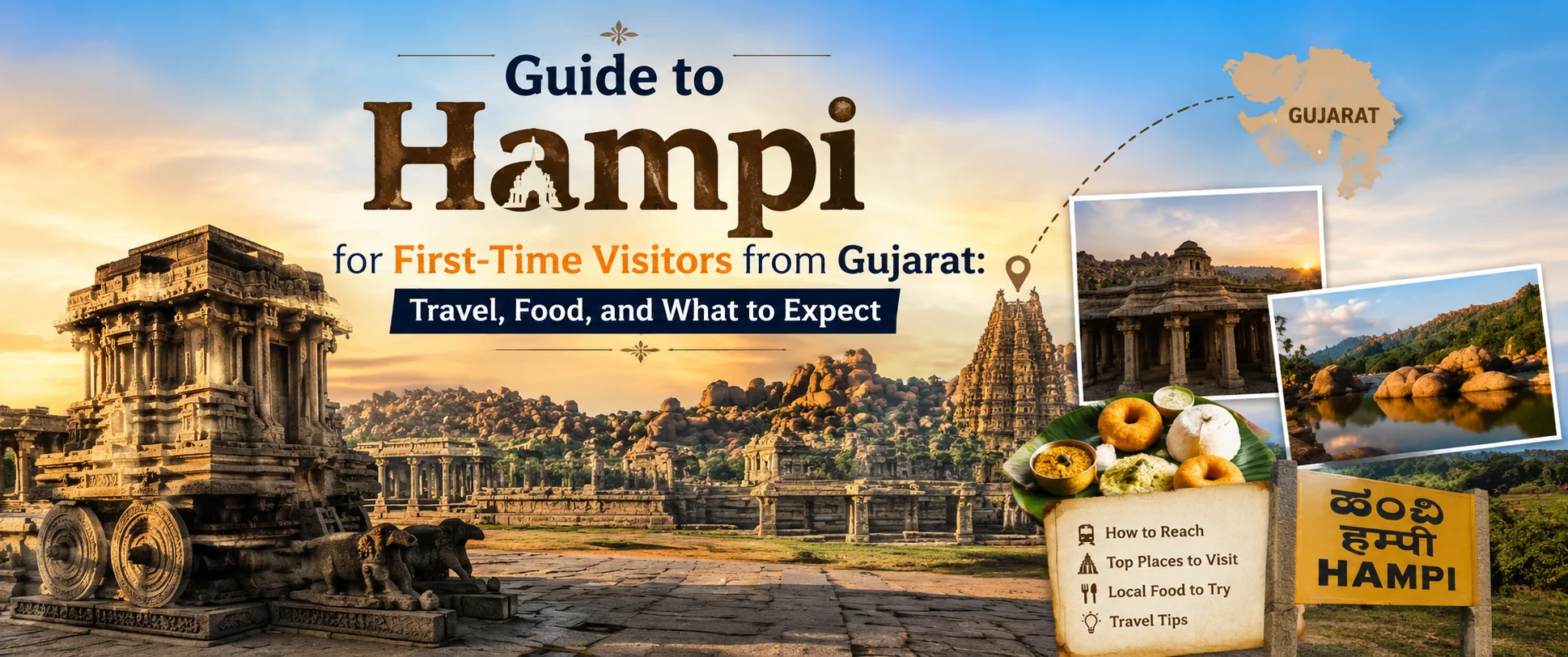
If you’re planning your first trip to Hampi from Ahmedabad, Surat, Vadodara, or anywhere else in Gujarat, most of the questions in your head right now aren’t really about the ruins. They’re about getting there, finding a proper thali, and figuring out what you’re actually walking into. This guide answers those questions in the order you’re probably asking them.
Hampi doesn’t look, sound, or feel like anywhere in Gujarat, and that’s largely the point of going. But a few honest, specific answers before you leave will save you a lot of guessing once you’re there — starting with the part everyone worries about first.
How do I actually get to Hampi from Gujarat?
The short version: there’s no direct flight and no direct train, and every route from Gujarat involves at least one change. The good news is that all of them are well-travelled and easy to book — it’s just worth deciding upfront whether you want speed or budget.
| From | Fastest route | Time | Budget route | Time |
| Ahmedabad | Fly to Hubli (via Bengaluru/Mumbai), then road | 6–8 hrs | Train to Hospet (via Hubli/Bengaluru) | 24–30 hrs |
| Surat | Fly to Bengaluru direct, then train/road | 7–9 hrs | Train to Hospet | 26–30 hrs |
| Vadodara | Fly to Bengaluru or Hubli, then road | 7–9 hrs | Train to Hospet | 24–28 hrs |
| Rajkot | Fly via Ahmedabad/Mumbai to Hubli, then road | 8–10 hrs | Train to Hospet (via Ahmedabad) | 28–32 hrs |
Two names to remember: Hubli Airport, roughly 150–165 km from Hampi (about 3–4 hours by road), is the nearest airport with regular domestic connections. Hospet Junction, just 13 km from Hampi, is the nearest railway station — Hampi itself has neither an airport nor a railway station of its own. Flying into Bengaluru is usually easier to book from Gujarat but adds a longer road or rail leg afterward (Hampi is around 340–350 km from Bengaluru).
Whichever route you pick, arrange your last-leg transport — cab, resort pickup, or KSRTC bus from Hospet — before you land, especially if you’re arriving late at night. Hospet’s taxi stand is straightforward but not something you want to be figuring out at 11pm after a 26-hour train journey.
Will I actually find vegetarian food?
Yes — more easily than in most parts of India you might travel to, and this is worth knowing before you leave rather than discovering with relief once you arrive. Hampi is a temple town built around the Virupaksha Temple, and in the immediate heritage core — Hampi Bazaar, the lanes around Virupaksha, and the main ghats — restaurants serve vegetarian food as a matter of local custom, and alcohol is generally not part of the menu. This isn’t a blanket law across the wider district, and rules around it have shifted over the years as the heritage zone has been managed more strictly, but for a visitor, the practical experience is simple: the closer you are to the temple core, the more consistently vegetarian the food will be.
That’s genuinely good news if you’re travelling from Gujarat. You won’t need to hunt for the one vegetarian option on a mixed menu — thalis, South Indian breakfasts, and multi-cuisine vegetarian cafés are the default rather than the exception in the areas you’ll actually spend most of your time.
What Jain travellers should know
Strict Jain food — without onion or garlic — is less automatic than plain vegetarian, but most established restaurants and resort kitchens in the area will prepare it if you ask when ordering, rather than expecting it to already be on the menu. If you’re staying at a resort with an in-house kitchen, it’s worth mentioning your requirements at check-in rather than at every meal.
What’s actually going to surprise me?
A few things tend to catch first-time visitors from Gujarat off guard — not in a bad way, just differently from what you’re picturing.
- The landscape isn’t green, and it isn’t meant to be.
Hampi sits inside a boulder field — giant, rounded granite rocks stacked across the terrain for kilometres. It looks almost lunar in the dry months and considerably greener if you visit just after the monsoon.
- The heat is a different kind of hot.
Gujarat’s summer heat is intense, but Hampi’s rocky terrain radiates heat back at you in a way that makes midday sightseeing genuinely uncomfortable between March and June, when temperatures regularly cross 38–40°C. Winter (October to February) is mild and pleasant — 16–32°C — and is when most people actually visit.
- Kannada is the local language, not Hindi.
You’ll get by fine in English and basic Hindi in tourist areas and at resorts, but don’t expect Hindi to work everywhere the way it might elsewhere. A handful of Kannada words for thank you (dhanyavada) and hello (namaskara) go a long way with locals.
- Cash still matters more than you’d expect.
UPI is widely accepted in resorts and larger restaurants, but smaller stalls, coracle rides, and some auto-rickshaws in and around the heritage core still prefer cash. Carry some.
- Temple dress codes are enforced, not suggested.
Shoulders and knees covered is the safe rule at Virupaksha and the other active temples. Shorts get you turned away at the entrance, not just a disapproving look.
- It’s genuinely a walking (and climbing) destination.
Many of the best viewpoints — Matanga Hill, Hemakuta Hill — involve a real climb over uneven boulder paths. Comfortable, broken-in shoes matter more here than at almost any other heritage site in India.
Where to stay in Hampi — and which part of it
This is the one decision that shapes everything else about your trip, because Hampi’s heritage zone is a UNESCO-protected core with heavy restrictions on new construction — which means most of the region’s actual hotels and resorts sit just outside it, in a scattering of distinct neighbourhoods. “Where to stay in Hampi” isn’t really one question; it’s four, depending on which of these areas you mean.
HAMPI BAZAAR / HERITAGE CORE
For budget travellers who want to be inside the action
Simple guesthouses and homestays right by Virupaksha Temple. You’re walking distance from everything, but rooms are basic, and commercial activity in this zone has been increasingly restricted by heritage authorities over the years — worth checking current status before booking here specifically.
KAMALAPURA & MALAPANAGUDI
Where most of Hampi’s proper hotels and heritage resorts actually are
Just beyond the core heritage zone, 5–8 km from the main ruins, this belt is where you’ll find the region’s standard, premium, and luxury accommodation side by side — from government-run KSTDC properties to heritage-style resorts with proper grounds, pools, and multi-cuisine (largely vegetarian) dining. If you’re searching for a genuine heritage resort in Hampi, Karnataka rather than a basic guesthouse, this is the belt most of them are in, and it’s the most practical base for a first Hampi trip — close enough for early starts at the ruins, comfortable enough for an actual holiday.
Vijayshree Resort sits in this category: a 20-acre property near the Royal Centre of the Vijayanagara ruins, built entirely around vegetarian, alcohol-free hospitality — which, if you’ve read this far, maps fairly directly onto what most Gujarati travellers are actually looking for in a first Hampi stay. Rooms run across seven categories, from Heritage Kutiya cottages to the Palace Wing’s Hemakuta Suite, and the grounds include a pool, spa, and organised heritage walks and cycling tours for guests who’d rather not figure out logistics themselves.
VIRUPAPUR GADDI / “HIPPIE ISLAND”
Across the river — a different atmosphere entirely
Reached by coracle or the upstream bridge, this side has a backpacker-café culture, rice paddy views, and — unlike the temple-side core — non-vegetarian food and alcohol are more freely available. It’s a different kind of trip from the one this guide is written for, but worth knowing exists if part of your group wants a change of pace for an afternoon.
HOSPET
The practical, no-frills option
The nearest sizeable town, 13 km out, with a wider spread of standard hotels at lower rates. Less atmosphere, but useful if you’re arriving very late by train and just need a bed before heading to the ruins the next morning.
Across all four areas, when people search for top hotels in Hampi or places to stay in Hampi, Karnataka, what they’re usually trying to work out is exactly this — which neighbourhood matches their trip. For a first visit from Gujarat, prioritising vegetarian dining and comfort over being literally inside the ruins, the Kamalapura resort belt is generally the easiest answer.
Vijayshree Resort — 20 acres near the Royal Centre, Kamalapura, Hampi. 100% vegetarian, alcohol-free, seven room categories.See rooms at Vijayshree Resort →
What should I actually see in two or three days?
Hampi has over 1,600 surviving structures spread across roughly 26 square kilometres, so the honest answer is: you won’t see all of it, and you shouldn’t try to. Here’s a realistic shortlist for a first visit.
Day 1 — The temple core
- Virupaksha Temple — still an active temple, dedicated to Shiva, and the spiritual centre of Hampi. Go early morning if you can.
- Hampi Bazaar — the old market street running up to the temple, good for a first sense of the town.
- Hemakuta Hill — a short climb, scattered with older shrines, and one of the best sunset points in Hampi.
Day 2 — The Royal Centre and Vittala Temple
- Vittala Temple & the Stone Chariot — Hampi’s most photographed structure, and worth the walk or cycle to reach it.
- Lotus Mahal & Elephant Stables — inside the Royal Centre, close to Vijayshree Resort’s own location, with a completely different architectural character from the temple structures.
- Queen’s Bath — a quieter, less-crowded stop most itineraries skip past too quickly.
Day 3 (if you have it) — Matanga Hill and the river
- Matanga Hill — the highest viewpoint over the whole boulder landscape, best at sunrise.
- A coracle ride on the Tungabhadra — a slower, different way to see the ruins from the water.
- Anegundi, across the river — a heritage village worth an afternoon if you want somewhere quieter than the main tourist circuit.
Time your trip around October to February if you can. Outside those months the heat makes midday sightseeing genuinely difficult, and several of the best viewpoints involve real climbing in direct sun.
Where to eat — and what to actually order
Restaurants in Hampi cluster around Hampi Bazaar and, increasingly, around Kamalapura since some of the older bazaar-area establishments relocated following heritage-zone restrictions. The food itself skews vegetarian, South Indian, and — thanks to decades of backpacker traffic — an odd but genuinely good mix of international café food alongside it.
- The vegetarian thali is the dish to build a meal around almost anywhere in Hampi — served on a banana leaf at most local restaurants, with rice, sambar, a couple of vegetable preparations, curd, and something sweet. It’s the closest local equivalent to a Gujarati thali, and most travellers from Gujarat find it comforting rather than unfamiliar.
- South Indian breakfast — dosa, idli, vada — is available everywhere and is a reliable, fast option before a morning of sightseeing.
- German-bakery-style cafés are a genuine Hampi quirk — a legacy of the town’s long-running backpacker culture — and are good for fresh bread, pancakes, and strong coffee if you want a change from Indian breakfast on day two or three.
- Resort dining is worth factoring in seriously if you’re staying somewhere like Vijayshree Resort, where the kitchen is entirely vegetarian by design — it removes the daily “will this place have something I can eat” question that can otherwise take up more mental energy than it should on a short trip.
The Gujarati traveller’s Hampi checklist
- Book your last-mile transport from Hubli or Hospet before you travel, not on arrival
- Pack for October–February if you have flexibility — otherwise pack for genuine heat, not just Gujarat-summer heat
- Comfortable, broken-in walking shoes — several of the best viewpoints involve boulder climbs
- Shoulders and knees covered for temple visits — carry a light scarf or stole even in warm weather
- Cash for smaller vendors, coracle rides, and rural stretches where UPI isn’t reliable
- Mention Jain dietary requirements at check-in rather than assuming every menu covers it by default
- A basic offline map — mobile signal thins out around some of the more remote ruins
- Sunscreen and a hat — the boulder landscape reflects heat more than it looks like it should
Quick Answers
Is Hampi a good first trip for a vegetarian family from Gujarat?
Yes. The town’s temple-core dining culture is predominantly vegetarian by custom, and resorts in the Kamalapura belt — including fully vegetarian properties — make it straightforward to avoid the food-hunting stress that can come with unfamiliar destinations.
What is the best area to stay in Hampi for a first-time visitor?
The Kamalapura and Malapanagudi belt, just outside the protected heritage core, offers the best mix of comfort, proper resort infrastructure, and proximity to the main ruins — generally the easiest answer to “where to stay in Hampi” for a first visit.
Is non-vegetarian food or alcohol available in Hampi at all?
Around the Virupaksha Temple and Hampi Bazaar core, restaurants are vegetarian by local custom and alcohol isn’t typically on the menu. Across the river at Virupapur Gaddi, both are more freely available, reflecting that area’s different, more backpacker-oriented culture.
How many days should I plan for a first Hampi trip?
Two full days covers the essential sites comfortably; three allows time for Matanga Hill at sunrise, a coracle ride, and Anegundi village without rushing.
Do I need a car, or can I get around without one?
Most visitors rent a scooter or hire an auto-rickshaw/car for the day, since the ruins are spread across a wide area. Cycling is also popular and genuinely pleasant in the cooler months.
Is Hampi safe and comfortable for solo women travellers?
Generally yes — it’s a well-established tourist circuit with a steady flow of domestic and international visitors. Standard precautions apply, particularly around dusk near less-populated ruin sites.
Hampi isn’t a difficult trip from Gujarat — it just requires a bit more planning than a domestic flight and a hotel booking, because the getting-there is genuinely the longest part. Once you’ve sorted the route, the food question answers itself faster than most first-timers expect, and the rest is really just deciding how many boulders you’re willing to climb.
Vijayshree Resort — 20 acres of vegetarian, alcohol-free hospitality near Hampi's Royal Centre.Check availability at Vijayshree Resort →