
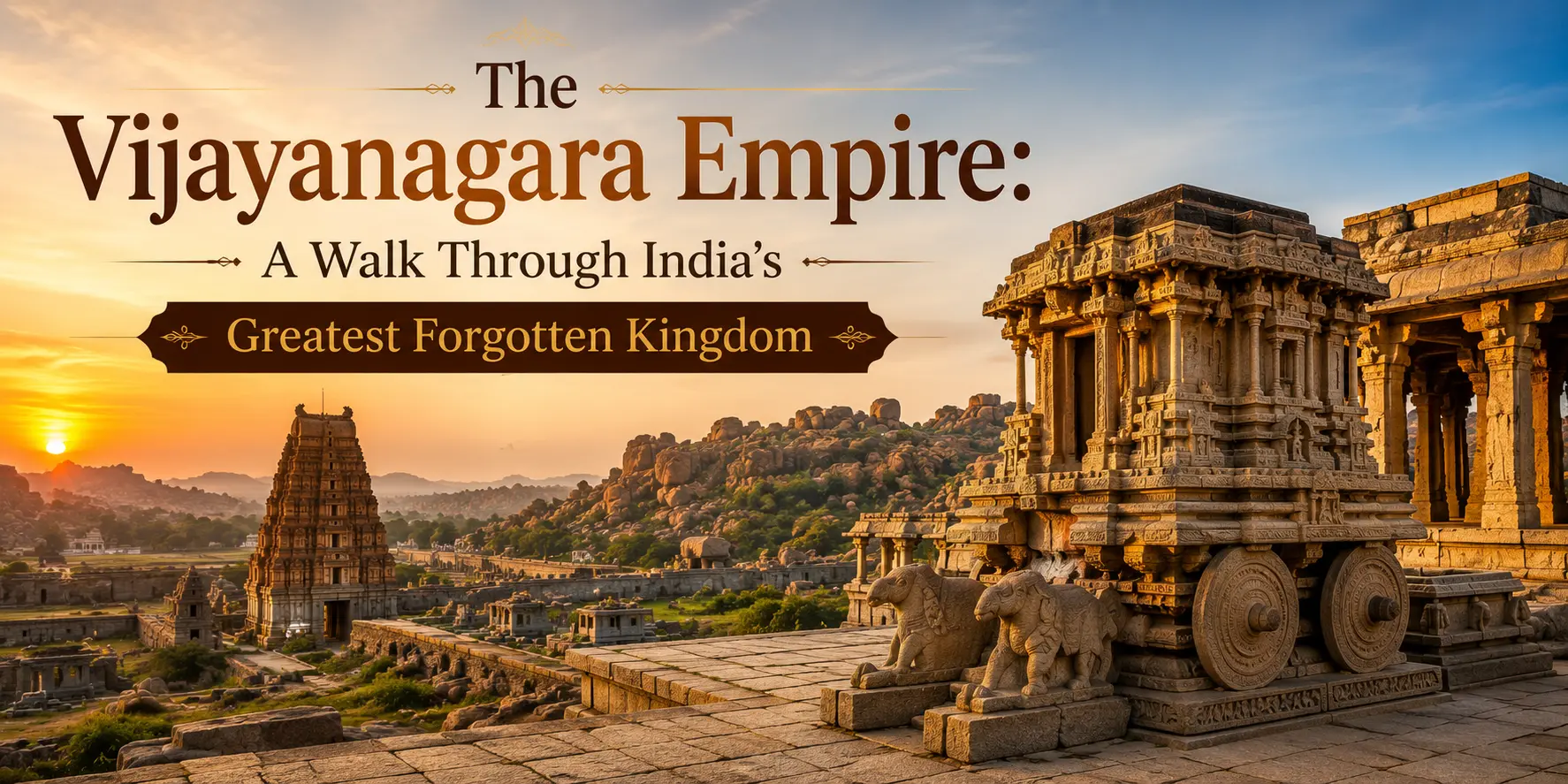
For over two centuries, an empire the size of a small continent ruled from a city its own visitors compared to Rome. Then, in a single afternoon of battle, it was gone. This is the story of Vijayanagara — and of the boulder-strewn town in Karnataka where its ruins still stand.
Most Indian schoolchildren learn the outline of the great northern empires — the Mauryas, the Guptas, the Mughals — in considerably more detail than they learn about Vijayanagara, a South Indian empire that at its height controlled territory from the Arabian Sea to the Bay of Bengal, ran a capital city some contemporary visitors ranked among the largest and wealthiest in the world, and left behind one of the most extraordinary archaeological landscapes anywhere on the subcontinent.
Today, that landscape is Hampi — a small town in Karnataka’s Ballari district, spread across a boulder-strewn valley on the banks of the Tungabhadra River, where the ruins of a forgotten kingdom are still being walked through, photographed, and slowly understood.
This is the story of that empire — how it began, how it briefly became one of the great powers of its age, how it fell in a single catastrophic battle, and what a visitor walking through its ruins today can still find standing.
A Kingdom Born from Resistance
The Vijayanagara Empire — the name means “city of victory” — was founded on 18 April 1336 by two brothers, Harihara I and Bukka Raya I, who had previously served under the Hoysala and Kakatiya dynasties before those kingdoms fell. Tradition holds that the brothers were guided and encouraged by the sage Vidyaranya, and that their new kingdom was conceived specifically as a bulwark against the Delhi Sultanate’s expanding reach into the Deccan and South India — a Hindu political and cultural counterweight at a moment when North Indian power was pushing steadily southward.
They built their capital on the southern bank of the Tungabhadra River, at a site that took its name, Hampi, from the local mother goddess Pampadevi. Over the following two centuries, four successive dynasties would rule from this city: the Sangama dynasty that founded it, the short-lived Saluva dynasty, the Tuluva dynasty that would produce the empire’s greatest ruler, and finally the Aravidu dynasty that carried on a diminished version of the empire after the capital itself was destroyed.
Krishnadevaraya and the Golden Age
If Vijayanagara has one name attached to its memory more than any other, it’s Krishnadevaraya, who ruled from 1509 to 1529 and is widely regarded as the greatest king in the empire’s history. His reign combined decisive military success — he defeated the Deccan Sultanates in the field, recovered the long-contested Raichur Doab, and expanded the empire’s authority to its greatest extent — with a level of cultural patronage rare among medieval Indian rulers.
Krishnadevaraya’s court hosted the Ashtadiggajas, eight celebrated Telugu poets, and the king himself was a genuine scholar-ruler, authoring the Telugu epic Amuktamalyada in addition to Sanskrit works. Under his patronage, temple construction, irrigation engineering, and courtly literature all flourished simultaneously — a combination of military strength and cultural ambition that made Vijayanagara, for a few decades, one of the most formidable and sophisticated powers anywhere in the world.
A City Foreign Travellers Compared to Rome
Vijayanagara’s reputation in its own time wasn’t confined to South India. Portuguese travellers who visited the city during its peak years left behind detailed written accounts describing a capital of extraordinary scale and wealth — broad markets selling gemstones in the open street, a population some later historians estimated may have made it the second-largest city in the world after Beijing during the 15th century, and a level of urban prosperity that visibly startled European visitors accustomed to the cities of their own continent.
Those accounts remain one of the most valuable outside windows into a South Indian capital at its height — evidence not just of an empire’s military reach, but of a genuinely cosmopolitan, wealthy, and remarkable city, at a scale that’s difficult to fully picture standing among the same site’s present-day ruins.
The Architecture That Still Speaks
Walking through Hampi today, the site’s most distinctive architectural signature is the deliberate blending of Dravidian temple tradition with forms borrowed from the Indo-Islamic architecture of the neighbouring Deccan Sultanates — rivals in politics, but clearly not in artistic influence.
- Virupaksha Temple: still an active place of worship today, predating the empire itself and remaining Hampi’s spiritual centre throughout Vijayanagara’s rise and fall.
- Vittala Temple and its Stone Chariot: the site’s single most photographed structure, famous for its ornately carved stone wheels and for a set of stone pillars that, when struck, genuinely produce musical notes — a detail that continues to astonish visitors today.
- The Lotus Mahal and Elephant Stables: structures in the old Royal Centre that show the clearest Indo-Islamic architectural influence — symmetrical arches and domed forms unlike the temple architecture found elsewhere on the site.
Together, these structures represent one of the most architecturally distinctive royal capitals to survive from medieval India — a city that absorbed influences from its rivals even as it fought them.
The Battle That Ended an Empire
By the 1560s, real power in Vijayanagara rested not with a crowned Aravidu monarch but with Aliya Rama Raya, son-in-law of Krishnadevaraya and the dominant statesman of his era. Rama Raya had spent years playing the rival Deccan Sultanates — Bijapur, Golconda, Ahmadnagar, and Bidar — against one another, at times allying with one against the others, and in the process earning a level of resentment and fear that eventually pushed all of them into an unprecedented alliance against him.
That coalition met the Vijayanagara army in battle in January 1565, near a village called Talikota — a confrontation also known as the Battle of Rakkasa-Tangadi. Despite Vijayanagara’s scale and resources, the battle turned decisively against it, partly through the death of its principal general in the fighting and partly through the Sultanates’ superior use of artillery. Rama Raya himself was killed, and the Vijayanagara army collapsed.
What followed was, in some ways, more devastating than the battle itself. Rather than attempting to defend the capital, the city’s rulers and nobility fled, and Vijayanagara was left to be systematically plundered and destroyed by the victorious forces over the following months. A capital that had astonished foreign visitors as one of the wealthiest cities on earth was reduced, within a matter of months, to the ruin that visitors walk through today.
The empire itself limped on in reduced form for another eight decades, its capital relocated first to Penukonda, then Chandragiri, then Vellore, before formally ending around 1646 — but the Vijayanagara that had rivalled Rome in the accounts of its own visitors never existed again after that January in 1565.
What Remains: Walking Through Hampi Today
The Group of Monuments at Hampi has been a UNESCO World Heritage Site since 1986, protecting a landscape of temples, royal structures, market streets, and irrigation works spread across a genuinely vast area — far larger than a single day’s visit can properly cover. The old Royal Centre, where the Lotus Mahal, Elephant Stables, and the empire’s administrative heart once stood, remains one of the site’s most evocative areas, a place where the empire’s scale and ambition are still legible in stone even five centuries after its fall.
Where to Stay While You Walk Through History
A site of this scale genuinely rewards more than a single rushed day, and where you stay while exploring it shapes the experience considerably. Hampi itself sits inside a UNESCO-protected heritage core with tight restrictions on new construction, which means most genuine hotels and resorts sit in the surrounding belt — Kamalapura and Malapanagudi specifically — rather than inside the ruins themselves.
- Hotels to stay in Hampi range from simple guesthouses in the Hampi Bazaar core to proper resort-style properties in the Kamalapura belt — the latter typically offering considerably more comfort for a multi-day visit.
- Places to stay in Hampi Karnataka worth prioritising are those close enough to the Royal Centre and main temple sites to allow early starts, since the site’s boulder terrain is best explored before the midday heat sets in.
- Top hotels in Hampi tend to be the ones offering genuine grounds, a pool, and vegetarian dining suited to the many pilgrims and heritage travellers the site draws — not just proximity to the ruins.
For a site built around a two-century historical narrative this rich, a single day rarely does it justice — which makes the choice of where to stay in Hampi as much a part of planning the trip as the sightseeing itself.
| Stay Inside the Royal Centre’s Own Neighbourhood Vijayshree Resort sits on 20 acres near Hampi’s historic Royal Centre — the same ground the Vijayanagara court once occupied. Explore Vijayshree Resort → |
What this Looks Like at Vijayshree Resort
Vijayshree Resort sits on 20 acres in the Kamalapura belt, close enough to the Royal Centre — the same ground once occupied by the Vijayanagara court’s Lotus Mahal and Elephant Stables — that early starts to the ruins are genuinely practical, not aspirational.
- Rooms and cottages: 97 rooms across seven categories, from Heritage Kutiya cottages to the Palace Wing’s flagship Hemakuta Suite, suited to both short heritage visits and longer, more considered stays.
- Pure vegetarian, alcohol-free dining: in keeping with the spiritual character of the wider Hampi site.
- Heritage walks and village cycling: guided experiences that extend the historical exploration beyond the monuments themselves, into the surrounding villages and rice paddies.
- A pool and spa: for the recovery a multi-day Hampi visit genuinely requires, given the site’s heat and walking distances.
| Book Your Stay Near Hampi’s Royal Centre Vijayshree Resort — 20 acres, seven room categories, and Hampi’s ruins within easy reach. Check Availability → |
Frequently Asked Questions
1. When was the Vijayanagara Empire founded, and by whom?
The empire was founded on 18 April 1336 by brothers Harihara I and Bukka Raya I of the Sangama dynasty, reportedly with the guidance of the sage Vidyaranya.
2. Who was the greatest ruler of the Vijayanagara Empire?
Krishnadevaraya, who ruled from 1509 to 1529, is widely regarded as the empire’s greatest king, combining military success against the Deccan Sultanates with extensive patronage of art, literature, and architecture.
3. What caused the fall of the Vijayanagara Empire?
A coalition of Deccan Sultanates defeated the Vijayanagara army at the Battle of Talikota in January 1565, after which the capital city was abandoned by its rulers and systematically plundered and destroyed over the following months.
4. Where should I stay when visiting Hampi?
Most genuine hotels and resorts sit just outside Hampi’s protected heritage core, in the Kamalapura and Malapanagudi belt, which offers easier access to the Royal Centre and main temple sites than options directly inside the historic core.
5. What are the best places to see in Hampi, Karnataka?
The Virupaksha Temple, the Vittala Temple with its Stone Chariot and musical pillars, and the Royal Centre’s Lotus Mahal and Elephant Stables are among the most significant surviving structures from the Vijayanagara Empire.
6. How many days should I plan to see Hampi properly?
Given the site’s scale and historical depth, two to three days allows a considerably more complete visit than the rushed single-day trip many visitors attempt.
Vijayanagara’s story is, in miniature, the story of how quickly even the greatest powers can be undone — an empire that ran from coast to coast, that hosted poets and built temples that still stand, brought down by a single afternoon of battle and a few months of plunder that followed it.
Its ruins are still there to be walked through. Vijayshree Resort sits close enough to make that walk an easy one.
| Plan Your Visit to Hampi Vijayshree Resort, near the Royal Centre, Hampi, Karnataka. Book Your Stay → |