
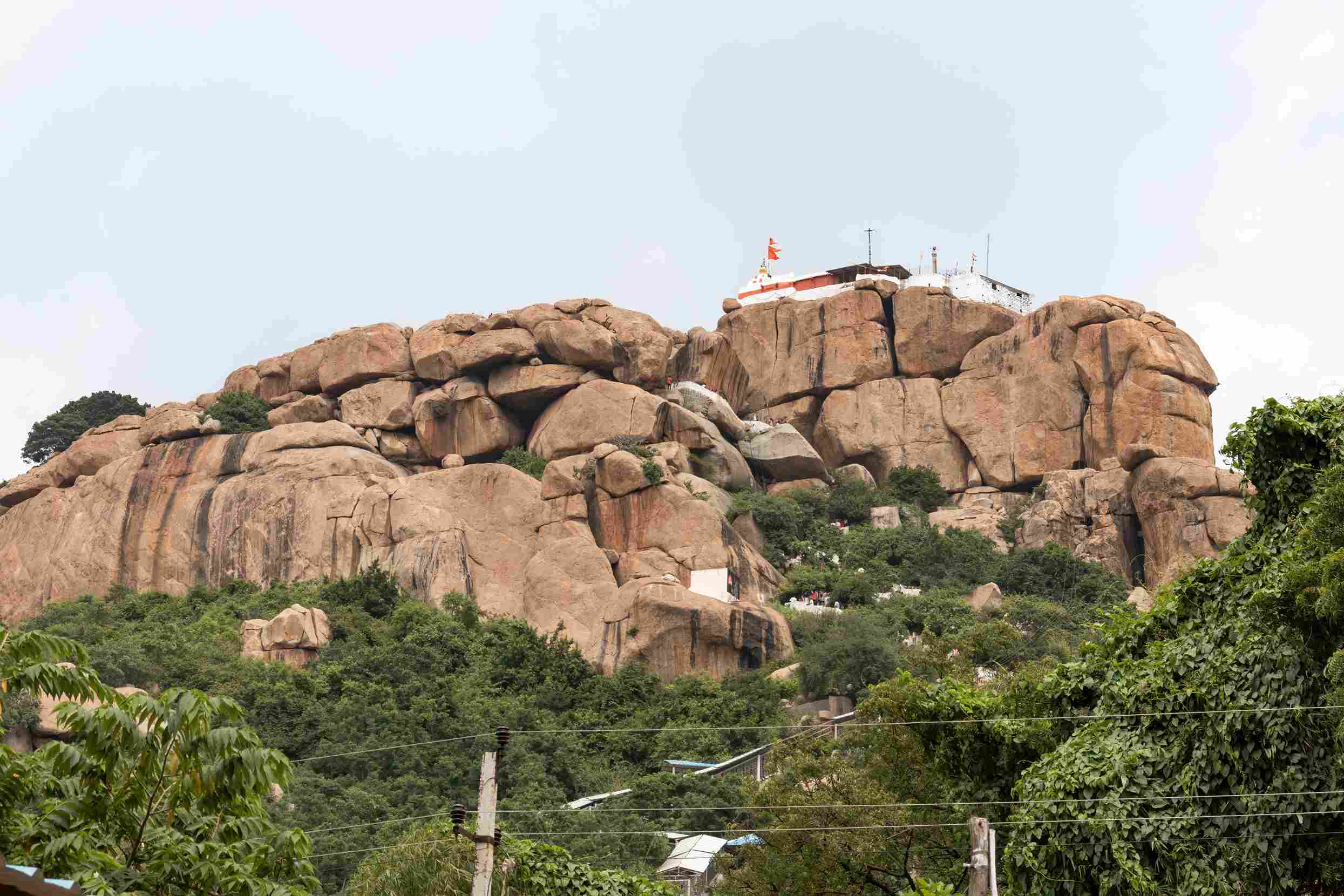
High above the Tungabhadra River, on a boulder-strewn hill overlooking the ancient landscape of Kishkindha, stands one of South India’s most spiritually significant pilgrimage sites. Anjaneyanadri Hill – believed to be the birthplace of Lord Hanuman – draws thousands of devotees, Ramayana pilgrims, and curious travelers to Anegundi every year.
Unlike many heritage sites around Hampi that attract primarily history enthusiasts, Anjaneyanadri Hill is first and foremost a place of living devotion. The air at the summit carries the fragrance of incense, the sound of bhajans drifts up from the temple, and on festival days the 550-step climb fills with pilgrims who have traveled from across India to stand at the place where, according to Hindu tradition, the greatest devotee of Lord Rama was born.
This guide covers everything a first-time visitor needs: the mythology behind the hill, both route options from Hampi, temple timings, practical tips for the climb, festival dates, and a suggested 2-day spiritual itinerary. If you are planning a pilgrimage to Hampi, this is the most important stop on the Anegundi side of the river.
Why Anjaneyanadri Hill Is One of India’s Most Sacred Pilgrimage Sites
The significance of Anjaneyanadri Hill goes far beyond being a temple on a hilltop. It sits at the heart of one of the oldest and most beloved narratives in Hindu tradition – the Ramayana.
The hill takes its name from Anjana Devi, Lord Hanuman’s mother. According to the Valmiki Ramayana and Puranic texts, Anjana Devi was an apsara (celestial being) who was cursed to be born as a vanara (forest dweller). She performed years of intense penance – tapasya – on this very hill, praying for a divine son. Her devotion was rewarded when Lord Vayu, the god of wind, blessed her, and she gave birth to Hanuman, the embodiment of strength, devotion, and selfless service.
Because Hanuman was born to Anjana Devi, he is called Anjaneya – literally ‘son of Anjana.’ He is also called Maruti (son of Vayu) and Pavanputra. These names are heard constantly in the prayers chanted by pilgrims as they climb the steps of Anjaneyanadri Hill.
For devotees of Lord Hanuman – and there are hundreds of millions across India – standing at the birthplace of their deity carries immense spiritual weight. Many pilgrims believe that a visit here, especially during Hanuman Jayanti, grants the same merit as visiting several other major Hanuman shrines combined.
The Ramayana Landscape Around Anjaneyanadri Hill
What makes this region extraordinary is that the spiritual significance does not stop at the hill. The entire landscape around Hampi and Anegundi is woven into the Ramayana story. Scholars and tradition alike identify this area as the ancient kingdom of Kishkindha – the home of the vanaras, where Lord Rama met Hanuman and Sugriva during his search for Goddess Sita.
Walking through this landscape with the Ramayana in mind transforms the experience entirely. Here is what each site means:
Pampa Sarovar – Where Shabari Waited for Lord Rama
Located a short distance from Anjaneyanadri Hill, Pampa Sarovar is a sacred lake mentioned in the Ramayana as the place where Shabari, an aged tribal devotee, waited years for Lord Rama’s arrival. The story of Shabari offering pre-tasted berries (ber) to Rama – out of her desire to give him only the sweetest – is one of the most beloved episodes in the epic, representing the power of pure bhakti. The lake is considered highly sacred, and many pilgrims take a ritual dip here.
Sugriva’s Cave – The Hiding Place of the Vanara King
Near the base of Anjaneyanadri Hill, a natural cave formation is identified in local tradition as the hiding place of Sugriva, the vanara king who had been driven from his kingdom by his brother Bali. It was here that Lord Rama met Sugriva through the introduction of Hanuman, and where the alliance was formed that would eventually lead to the rescue of Sita. The cave is a short walk from the base of Anjaneyanadri Hill and is well worth visiting before or after the climb.
Yantrodharaka Hanuman Temple – Installed by Saint Vyasaraja
This important Hanuman temple in Hampi town was not just built – it was consecrated by the 15th-century Vaishnava saint and philosopher Vyasaraja, who is credited with installing 732 Hanuman idols across South India to protect the Vijayanagara kingdom. The deity here is believed to be especially powerful and is worshipped as ‘Yantrodharaka’ – the remover of obstacles through divine instruments (yantras). Most pilgrim itineraries include this temple alongside Anjaneyanadri Hill.
Anegundi – The Living Kishkindha
The village of Anegundi, just across the river from Hampi’s main ruins, is identified by many historians and religious traditions as the core of ancient Kishkindha. Unlike the monument-heavy Hampi side, Anegundi retains the feel of a living heritage village – anana plantations, traditional homes, and a quiet rhythm that has changed little over centuries. Anjaneyanadri Hill rises directly above Anegundi, making the mythological connection feel tangible.
How to Reach Anjaneyanadri Hill from Hampi
Getting to Anjaneyanadri Hill from Hampi requires crossing the Tungabhadra River, and there are two distinct ways to do this. Choosing the right route based on your group, fitness level, and preferences makes a significant difference to the experience.
Option 1: Coracle Ride Route (Most Popular – Best Experience)
This is the classic pilgrim route and the one most visitors remember long after the trip.
- Start from the Virupaksha Temple side in Hampi
- Walk to the Tungabhadra riverbank (approximately 5 minutes from the temple)
- Board a coracle – a traditional round wicker-and-tar boat – to cross the river
- From the opposite bank, take an auto-rickshaw or walk the 2 km to the base of Anjaneyanadri Hill
Coracle fare: Approximately Rs. 30–100 per person (varies by season and negotiation – confirm on arrival)
Auto-rickshaw to hill base: Approximately Rs. 50–80 for a group, varies by timing
Is the coracle ride safe? Yes – coracles have been used here for generations by locals and tourists alike. A few practical points: avoid boats that appear overloaded, cross during daylight hours, and elderly visitors or young children should board carefully as the boats are round and can wobble. Most visitors find the coracle ride itself a memorable part of the pilgrimage.
Option 2: Road Route via Anegundi Bridge (Most Comfortable)
Families with senior citizens, visitors with mobility concerns, or those arriving by private vehicle generally prefer this route.
- Distance: approximately 30–35 km from central Hampi via the Anegundi bridge
- Travel time: roughly 45–60 minutes depending on road conditions and traffic
- The road route takes you through the Anegundi village approach, which is scenic and easy to navigate
Guests staying at Vijayshree Resort & Heritage Village can arrange private cab transfers to Anjaneyanadri Hill through the resort front desk. The team regularly assists guests with early morning departures to catch the sunrise at the summit.
Temple Timings, Entry Fee & Essential Information
Temple timings: Generally 6:00 AM to 6:00 PM daily (confirm locally as timings may vary during festivals)
Entry fee: No entry fee – the hill and temple are free to visit
Photography: Permitted on the hill and at the summit; check with the priest before photographing inside the inner sanctum
Mobile phones: Permitted on the climb and at the summit
Sunrise visits (arriving at base by 6:00–6:15 AM) are strongly recommended for three reasons: the temperature is significantly cooler, the climb feels easier, and the panoramic views of Hampi’s boulder landscape and Tungabhadra River at first light are genuinely spectacular.
The Climb: What to Expect
The ascent to the Anjaneya Hanuman Temple involves climbing approximately 550 to 575 steps. The steps are paved and reasonably well-maintained, making this a very different experience from the boulder-scramble of Matanga Hill. Here is what to expect at each stage:
- Lower section (steps 1–150): Gentler incline, some shade from trees, small stalls selling water and flowers for the temple
- Middle section (steps 150–400): Steeper sections with railings; occasional rest platforms with views of Anegundi below
- Upper section (steps 400–550): Increasingly open with full sun exposure; the most physically demanding part
- Summit: Anjaneya Hanuman Temple, panoramic views in all directions, usually a small gathering of pilgrims throughout the day
Difficulty and Accessibility
The climb is rated moderate. Most reasonably healthy adults complete it in 30 to 45 minutes at a comfortable pace with stops for rest and water. Senior citizens regularly complete the climb – the key is starting early (before 8 AM) and taking frequent breaks at the rest platforms. Carrying at least one litre of water per person is essential. After 9 AM in summer months, the open upper section becomes very hot.
Are there railings? Yes, railings are present along most of the steeper sections. Is there shade? Limited, particularly in the upper third of the climb. This is why early morning visits are not just recommended but genuinely important for comfort and safety during the summer months (March to June).
About the Monkeys
This is one of the most important practical tips for visitors and one that most travel blogs fail to mention: monkeys are present in significant numbers around Anjaneyanadri Hill, particularly near the middle and upper sections of the climb. They are bold and accustomed to human presence.
- Do not carry visible food packets or uncovered snacks
- Keep mobile phones and sunglasses inside bags or pockets when not in use
- Do not feed the monkeys – it encourages them to approach more aggressively
- If a monkey approaches, stay calm and do not make sudden movements
The monkeys are not dangerous if visitors are sensible, but ignoring this advice has led to food being snatched and occasional minor incidents. Being aware of this beforehand prevents any surprises.
What to Carry for the Climb
- Water – minimum 1 litre per person, more in summer
- Comfortable walking shoes or sports sandals with grip (not flat slippers)
- Cap, hat, or small umbrella – essential for sun protection on the open upper section
- Light snack for energy – keep it in a sealed bag inside your backpack
- Cash – small denominations for coracle fare, auto-rickshaw, and temple offerings
- Prasad flowers or coconut if you wish to offer something at the temple
- Mobile phone with a good charge – the views at the summit are worth photographing
- A light shawl or scarf for women who wish to cover their head inside the temple
Best Time to Visit Anjaneyanadri Hill
By Season
- October to February: Best season overall – cool weather, clear skies, pleasant climb
- March to May: Hot and increasingly humid; early morning visits (before 8 AM) are essential
- June to September: Monsoon season – the hill is lush and dramatically green but the steps can be slippery; the coracle service may be suspended during heavy rains
By Time of Day
- Sunrise (6:00–7:30 AM): Best for spiritual atmosphere, cooler temperatures, and the most memorable views
- Sunset (4:30–6:00 PM): Beautiful light and cooler than midday; the temple is usually less crowded than mornings
- Midday: Not recommended, especially in summer – the open sections of the climb become very hot
Festivals at Anjaneyanadri Hill
The hill and temple come alive during two major annual festivals. If your travel dates align with either of these, the experience is unlike any ordinary day visit.
Hanuman Jayanti
Hanuman Jayanti – the birth anniversary of Lord Hanuman – falls on the full moon day of the Chaitra month, typically in April. At Anjaneyanadri Hill, this is the most important day of the year. Pilgrims begin arriving the previous evening, and by early morning on the festival day, the queue of devotees stretches all the way down the 550 steps and into the village below. Special abhishekam (ritual bathing of the deity), bhajans, and community meals (prasad) are organized at the summit.
If you plan to visit during Hanuman Jayanti, arrive before 5 AM and expect large crowds. The atmosphere is electrically devotional.
Ram Navami
Ram Navami – the birth anniversary of Lord Rama – falls in March or April and is also celebrated at Anjaneyanadri Hill, given the close connection between Hanuman and Rama in the Ramayana story. The celebrations are more intimate than Hanuman Jayanti but still attract a significant number of pilgrims, particularly those doing the full Kishkindha circuit (Anjaneyanadri Hill, Pampa Sarovar, Sugriva’s Cave, and Yantrodharaka Hanuman Temple in one day).
Karthik Purnima
The full moon of the Karthik month (October–November) is considered auspicious across many Vaishnavite and Shaiva traditions. Evening visits to the hill during Karthik Purnima, with the full moon rising over the Hampi landscape, are a particularly atmospheric experience reported by regular visitors.
Anjaneyanadri Hill vs Matanga Hill — Which Should You Visit?
Both hills are among the most visited natural landmarks around Hampi, but they offer very different experiences. Here is a detailed comparison to help you decide – or plan both.
| Feature | Anjaneyanadri Hill | Matanga Hill |
| Main experience | Spiritual pilgrimage | Scenic trekking & sunrise |
| Famous for | Birthplace of Lord Hanuman | Panoramic Hampi sunrise views |
| Type of climb | 550+ paved steps with railings | Rocky, uneven boulder trek |
| Difficulty | Moderate — suitable for families | Moderate–challenging |
| Ideal for | Devotees, families, seniors | Adventure & photography lovers |
| Temple at summit | Yes — Anjaneya Hanuman Temple | Small shrine only |
| Mythology connection | Ramayana (Kishkindha, Hanuman) | Minor mythological reference |
| Best time of day | Sunrise (spiritual atmosphere) | Sunrise (panoramic views) |
In short: if you are visiting Hampi primarily for spiritual or mythological reasons, Anjaneyanadri Hill is non-negotiable. If you are coming for the landscape and photography, Matanga Hill’s sunrise is one of the most iconic views in South India. Many visitors with two days in Hampi do Matanga Hill sunrise on Day 1 and Anjaneyanadri Hill on Day 2 – which is exactly what the itinerary below suggests.
Suggested 2-Day Spiritual Itinerary from Hampi
Day 1 – The Hampi Side: Temples, History, and the River
- Early morning: Virupaksha Temple – the living heart of Hampi, continuously active since the 7th century
- Mid-morning: Vittala Temple complex – home to the iconic Stone Chariot and the famous musical pillars
- Afternoon: Tungabhadra River ghats – peaceful, ideal for a short rest or meditation
- Late afternoon: Yantrodharaka Hanuman Temple – an important Hanuman shrine before tomorrow’s pilgrimage
- Evening: Matanga Hill sunset – one of the finest viewpoints in Hampi for end-of-day light
Day 2 – The Anegundi Side: Kishkindha, Myth, and the Birthplace
- Pre-dawn: Depart early (5:00–5:30 AM) – take the coracle across the Tungabhadra at first light
- Sunrise climb: Begin the 550 steps at Anjaneyanadri Hill as the sun rises over the boulder landscape
- Temple visit: Offer prayers at the Anjaneya Hanuman Temple at the summit; take in the panoramic views
- Mid-morning: Descend and visit Sugriva’s Cave nearby
- Late morning: Pampa Sarovar – the sacred lake connected to the story of Shabari and Lord Rama
- Afternoon: Explore Anegundi village – heritage walks, local crafts, and the quieter pace of Kishkindha
Guests at Vijayshree Resort & Heritage Village can arrange early departure vehicles, packed breakfasts, and guided cultural walks through Anegundi village. The resort is approximately [X km] from the Anegundi bridge route to Anjaneyanadri Hill – a straightforward drive without Hampi’s main-street congestion.
Where to Stay for a Comfortable Pilgrimage
Early morning departures – the kind required to reach Anjaneyanadri Hill for sunrise — are far easier when your accommodation is peaceful, check-out is flexible, and staff can help arrange transport. Hampi has a range of options from budget guesthouses to heritage resorts.
Vijayshree Resort & Heritage Village is among the preferred choices for pilgrimage travelers and families due to its heritage-inspired architecture drawn from the Vijayanagara tradition, spacious rooms, and location that provides access to both the Hampi-side monuments and the Anegundi-side pilgrimage circuit. The resort team regularly assists guests with sunrise transport arrangements, coracle timings, and Ramayana circuit itineraries.
Conclusion
Anjaneyanadri Hill is not a destination that announces itself. There are no neon signs, no ticketing queues, and no automated audio guides. What it offers instead is something rarer: a direct, unmediated encounter with one of India’s oldest living devotional traditions, set against a landscape that has been considered sacred for millennia.
The climb, the temple, the views, the story of Anjana Devi’s penance and Hanuman’s birth – all of it comes together in a way that is hard to describe and easy to feel. Whether you are a lifelong devotee of Lord Hanuman or a first-time visitor to Hampi simply curious about the Ramayana world, Anjaneyanadri Hill deserves more than a half-hour stop on the way back from the ruins.
Plan a full morning. Start before sunrise. Bring water. And leave time to sit at the summit after the prayers settle.
Frequently Asked Questions
How do I reach Anjaneyanadri Hill from Hampi?
There are two routes. The most popular is the coracle ride: walk to the Tungabhadra riverbank near Virupaksha Temple, take a coracle across (approximately Rs. 30–100 per person), then take an auto-rickshaw to the hill base. The second option is the road route via the Anegundi bridge — approximately 30–35 km from central Hampi, taking about 45–60 minutes by car.
How long does it take to climb Anjaneyanadri Hill?
Most visitors take 30–45 minutes to climb the approximately 550 steps at a comfortable pace with breaks. The descent typically takes 20–30 minutes. Allow 2 to 2.5 hours total for the visit including temple prayers and time at the summit.
What are the timings of Anjaneyanadri Hanuman Temple?
The temple is generally open from 6:00 AM to 6:00 PM daily. Timings may vary during major festivals such as Hanuman Jayanti. Confirm with locals or your accommodation on the day of your visit.
Is there an entry fee at Anjaneyanadri Hill?
No. There is no entry fee to climb the hill or visit the temple. Small charges apply for the coracle crossing and auto-rickshaw to the base.
Can senior citizens climb Anjaneyanadri Hill?
Yes — many senior devotees complete the climb regularly. The steps are paved and railings are available on most steep sections. Starting early morning (before 8 AM) when temperatures are cool, carrying adequate water, and taking frequent breaks at the rest platforms makes the climb manageable. Those with serious knee or heart conditions should consult a doctor before attempting the climb.
Are there monkeys on the hill? Is it safe?
Yes, monkeys are present throughout the hill, particularly in the middle and upper sections. They are generally harmless but can be opportunistic. Do not carry visible food, keep phones and sunglasses in your bag, and do not feed them. Taking these precautions makes the climb entirely safe and incident-free.
What is the best time to visit Anjaneyanadri Hill?
October to February is the best season for comfortable weather. For the best experience within any season, sunrise visits (arriving at the base by 6:00 AM) are strongly recommended for cooler temperatures and spectacular views. Hanuman Jayanti (April full moon) and Ram Navami (March–April) are the most significant festival times to visit.
What is the difference between Anjaneyanadri Hill and Matanga Hill?
Anjaneyanadri Hill is primarily a spiritual pilgrimage site — it has a major Hanuman temple at the summit and is believed to be the birthplace of Lord Hanuman, making it deeply significant for devotees. Matanga Hill is known for its panoramic sunrise views over Hampi and is popular with photographers and trekkers. The climb on Matanga Hill is a rockier, more uneven trek compared to the paved steps of Anjaneyanadri. Both are worth visiting if you have two days in Hampi.
Where is the nearest heritage resort to Anjaneyanadri Hill?
Vijayshree Resort & Heritage Village is located near Hampi and provides convenient access to both the Hampi-side monuments and the Anegundi-side pilgrimage circuit including Anjaneyanadri Hill. The resort team can assist with early morning transport arrangements and Ramayana circuit itineraries.
What should I carry for the Anjaneyanadri Hill climb?
Carry at least 1 litre of water per person, comfortable closed shoes or sports sandals with grip, a cap or umbrella for sun protection, small cash for transport and temple offerings, and a mobile phone with sufficient charge. A sealed snack in your backpack is useful; avoid carrying visible food because of the monkeys on the hill.
Is Anjaneyanadri Hill connected to the Ramayana?
Yes, deeply. The hill is believed to be the birthplace of Lord Hanuman, born to Anjana Devi who performed penance here. The surrounding region – Anegundi, Hampi, Pampa Sarovar – is identified by tradition and some scholars as the ancient Kishkindha kingdom described in the Ramayana. This makes the entire area one of the most significant Ramayana-linked landscapes in India.
About the Author Written by the Harsh – a team member that regularly accompanies guests on early morning visits to Anjaneyanadri Hill, Pampa Sarovar, and the Ramayana heritage circuit around Anegundi. All practical details in this guide reflect first-hand observation and are reviewed and updated seasonally.